Are Old Bibles and Leather-Bound Books Worth Anything?
Usually not much, and here is the honest reason why. Plus the real exceptions: the early printings and genuinely rare leather-bound books that are worth money.
Robin Swain
Author

A shelf of antique leather-bound books with worn gilt decoration on the spines.
An old family Bible and a shelf of leather-bound classics are the two books people are most sure must be worth something. They are heavy, handsome, generations old, and they look exactly like what a valuable book is supposed to look like.
The honest answer, most of the time: not much. And the reason is worth understanding, because it is the same reason a plain-looking novel from 1996 can be worth more than a Bible from 1870.
The short answer
- Most old Bibles are worth little. They were printed in enormous numbers, and rarity, not age, drives value.
- Family Bibles carry real sentimental value, and the handwritten family records inside can matter to genealogists, but collector value is usually modest.
- Leather bindings prove nothing. Publishers mass-produced decorative leather reprints by the thousand.
- The exceptions are real: very early printings, historically important editions, and genuinely rare works in any binding can be worth serious money.
Why age and looks are not value
Book value comes from rarity, demand, and condition together. Bibles fail the rarity test spectacularly: the Bible is the most printed book in history, and the big 19th-century family editions were produced by the wagonload. However old the date on the title page, thousands of siblings survive.
Leather fails a different way. A leather binding was often just the deluxe packaging of its day. Publishers bound dictionaries, encyclopedias, and "great classics" sets in handsome leather specifically to look impressive on a shelf. The binding is decoration; the printing inside is what collectors price, and a decorative reprint is still a reprint. This is the same trap as age, covered in Is My Old Book Worth Anything?.
What a typical family Bible is actually worth
A 19th-century American or British family Bible, the large one with the brass clasp and the births and deaths written in the front, typically sells for modest money, often under a hundred dollars, sometimes a bit more if the binding is exceptional and intact.
What it does carry is worth naming plainly. The family record pages are a primary genealogical document, and to your own family that page is irreplaceable. Photograph those pages, keep the book if it means something, and do not feel cheated by the market number. Sentimental value and market value are different measurements. If the Bible came to you in an estate, What to Do With a Box of Inherited Books covers the wider sort.
The exceptions that are genuinely valuable
Old Bibles as a category are common. Specific printings are anything but:
- The earliest printed Bibles. A Gutenberg Bible is one of the most valuable books on earth; complete copies are essentially all in institutions, and even single leaves have sold for five and six figures.
- The 1611 King James first edition. The true first printing of the KJV is a six-figure book at auction.
- Early Geneva Bibles. A 1560 first edition runs well into five figures, and even the smaller Geneva printings of the 1580s and 1590s bring hundreds to a few thousand dollars.
- Historically notable editions: first printings in a language, famous misprints, and early American printings all have real collector markets.
The pattern: the value lives in which printing, never in "old Bible" as a category. The same rule as every other book.
How to tell if your leather-bound book is the real thing
A quick sorting test for any leather-bound shelf:
- Check the title page and copyright page. A reprint usually says so: a later date, a reprint publisher's name, "printed from the original edition."
- Sets are usually decorative. Matched leather "complete works" sets were sold as furniture. Exceptions exist, but the default is modest.
- Genuinely early books look their age inside. Handmade paper, irregular type, no ISBN, no modern publisher marks. An 1806 book reads very differently from an 1980 leather reprint of it.
- Condition still rules. Even for the exceptions, a detached board or a crumbling spine takes most of the money off the table. See Book Condition Grading Explained.
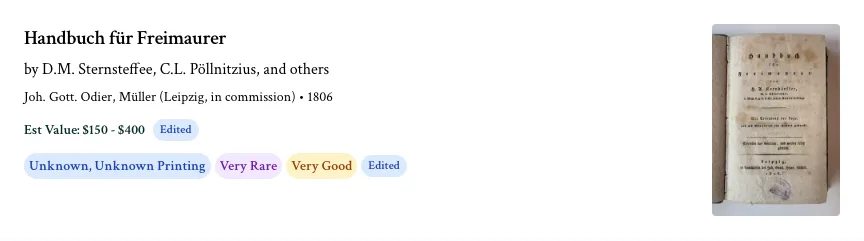
Genuinely old and rare does not automatically mean expensive, either. Here is a real one from our own assessments: an 1806 German Masonic handbook, leather-bound, genuinely very rare, in Very Good condition, and the estimate is $150 to $400. Rarity without broad collector demand earns respectable money, not a windfall.
The faster way to find out
FirstFolio is an AI tool that identifies and values old books from photos. You upload pictures of the cover, title page, and copyright page, and it identifies the edition and printing, grades the condition, and returns an estimated market value range in about 60 seconds. It will tell you whether your Bible or leather-bound book is a common printing or one of the exceptions, before you spend anything on an appraisal.
You can check two books free, no card required. Find out what your book is worth.
Frequently asked questions
Is my old family Bible worth money? Usually not much. Family Bibles were printed in huge numbers, so collector value is typically modest. The handwritten family record pages carry real genealogical and sentimental value, which is a different thing from market price.
Are leather-bound books valuable? The binding alone, no. Publishers mass-produced decorative leather reprints and sets. Value depends on which printing is inside the leather, plus rarity, demand, and condition.
Which old Bibles are actually valuable? The earliest and most historically important printings: Gutenberg Bibles, the 1611 King James first edition, early Geneva Bibles, and other landmark editions. These are rare enough that most people will never handle one.
How can I tell if my Bible is a valuable edition? Check the title page and copyright page for the printer, place, and date, then have the specific printing identified. Age alone tells you almost nothing; the printing is everything.
Should I get my old Bible appraised? Only if a quick check suggests it might be one of the genuinely early or notable printings. Paying for a formal appraisal on a common 19th-century family Bible usually costs more than the book is worth. See How to Get a Book Appraised.
Related reading: