Book Condition Grading Explained
Fine, Very Good, Good, Fair, Poor: what each grade actually means, what moves a book down the scale, and why one grade can double or halve the price.
Robin Swain
Author
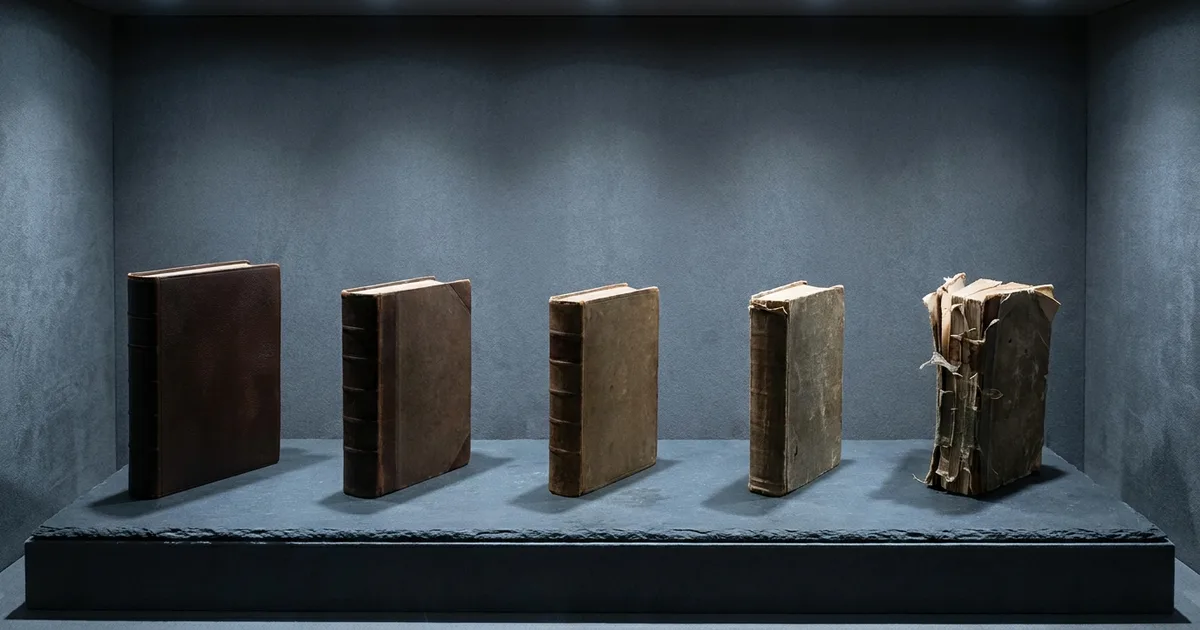
Five old books in a row, ranging from pristine to visibly battered.
Every listing for a used or rare book leans on the same short words: Fine, Very Good, Good. They look casual. They are not. They are a grading scale with agreed meanings, and the gap between two neighboring grades is often the difference between hundreds of dollars and lunch money.
The scale reads more optimistically than plain English, which is the part that trips people up. In bookseller grading, "Good" is not good. It is the average, worn copy.
Here is what each grade means, what knocks a book down the scale, and how to grade your own shelf honestly.
The short answer
From best to worst, the standard grades are:
- As New: exactly as it left the publisher. No flaws at all.
- Fine: nearly new, no damage, just the faint settling of time.
- Very Good: shows wear, but no tears and nothing missing. The collector's floor.
- Good: the average used copy. Worn but complete.
- Fair: heavily worn, complete text, but may be missing endpapers or even the half-title.
- Poor: a reading copy. The text survives; not much else does.
The dust jacket is graded separately, and a missing jacket is always noted.
Where the scale comes from
These terms are not one seller's invention. The scale was proposed by AB Bookman's Weekly, a trade magazine, back in 1949, and the book trade has used it ever since. When a dealer in London and a dealer in Ohio both write "VG," they mean roughly the same thing. That shared vocabulary is what makes sold prices comparable, which is why grading your book against the same scale matters before you look up what it is worth.
What each grade really means
As New and Fine. As New means flawless, as issued. Fine allows only the gentlest signs that time has passed: an unread copy, cared for, nothing to report. No names inside, no fading, no bumps. Most books that have lived on a shelf for decades do not qualify, which is exactly why Fine copies command the premium they do.
Very Good. The workhorse grade. The book shows honest wear, rubbed edges, a gently bumped corner, maybe a previous owner's name, but nothing is torn and nothing is missing. For most collectors this is the minimum grade worth buying for all but the rarest titles.
Good. Average and worn: cocked spine, edgewear, soiling, perhaps an inscription. Complete, readable, unlovely. In plain English you might call this "fine, whatever." In bookseller English it is two grades below Fine, and priced like it.
Fair and Poor. Fair means heavily worn but textually complete, though non-essential pages like endpapers or the half-title may be gone. Poor means the only thing left to sell is the words: stained, shaken, ex-library, held together out of habit. Reading copies, priced accordingly.
What actually moves a grade
Graders subtract, they do not add. The common deductions:
- Water damage and staining. Wavy pages or tide marks drop a book fast, often below Good on their own.
- A cracked hinge or shaken binding. Open the cover; if the endpaper is splitting at the fold, the grade falls.
- Foxing. The rust-brown spots that freckle old paper. Light foxing is tolerated on older books; heavy foxing pulls the grade.
- Writing and stamps. An owner's name is minor. Underlining, margin notes, and library stamps are not.
- Fading and sunning. A spine bleached by sunlight is one of the most common flaws on otherwise nice copies.
- Missing anything. A torn-out map, a lost endpaper, a clipped flap. Completeness is the line between the middle grades and the bottom ones.
The jacket takes its own grade for the same flaws: chips, closed tears, sunned spine, price-clipping. On collectible hardcovers the jacket's grade can matter more than the book's, since the jacket is often most of the value. See Do Dust Jackets Affect a Book's Value?.
Why half the scale carries most of the money
Collectors pay for the copies that barely exist: the survivors near the top of the scale. Prices do not step down evenly, they fall off a cliff. A Fine copy in a Fine jacket might bring several times what a Very Good copy of the same printing brings, and a Good copy might fetch a tenth of the Fine one. Meanwhile the difference between Fair and Poor is often a few dollars either way.
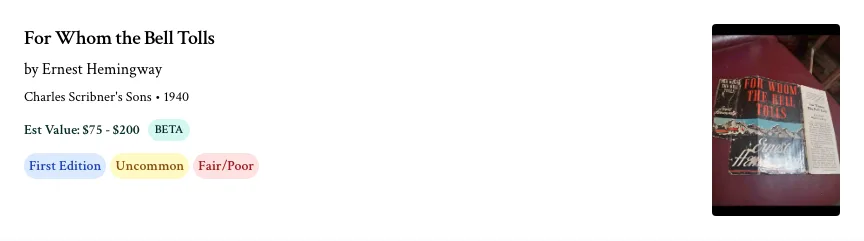
Hemingway's For Whom the Bell Tolls shows the cliff clearly. Dealer pricing for the 1940 first printing runs roughly $2,000 and up with its jacket in Fine condition, around $500 to $700 with a Very Good jacket, and well under $200 for a worn copy. Same book, same printing, same words inside. The grade is the whole gap.
How to grade your own book honestly
Sellers overgrade, buyers know it, and an overgraded listing just gets returned. Work through it like a grader:
- Take the jacket off and inspect the boards, spine ends, and corners.
- Open the covers and check both hinges.
- Flip the text block: foxing, stains, writing, missing pages, loose maps or plates.
- Grade the jacket separately: tears, chips, fading, the price corner.
- State the flaws instead of rounding up. "Very Good with a sunned spine" reads as honest and sells; "Fine" that arrives sunned reads as a scam.
The faster way to a grade and a number
FirstFolio is an AI tool that identifies and values old books from photos. You upload pictures of the cover, title page, and copyright page, and it identifies the edition and printing, grades the condition, and returns an estimated market value range in about 60 seconds, so the grade and the price arrive together instead of you guessing at either.
You can check two books free, no card required. Get your book graded in 60 seconds.
Frequently asked questions
What do book condition grades mean? They are the book trade's standard scale, from As New and Fine at the top through Very Good and Good to Fair and Poor. Fine means essentially flawless; Good means an average worn copy; Poor means a reading copy where only the complete text has value.
What is the difference between Very Good and Good condition? Very Good shows wear but no tears and nothing missing. Good is the average used copy: complete, but worn enough that collectors consider it below the usual floor for collecting.
Does condition really affect a book's value that much? Yes, more than almost anything except the printing itself. Prices fall off steeply as grades drop; a Fine copy can bring several times a Very Good one, and ten times a Good one.
What is foxing on a book? Rust-colored spots that develop on old paper. Light foxing is common and tolerated on older books; heavy foxing lowers the grade and the price.
Is a book graded with or without the dust jacket? Separately. A listing like "VG/VG" grades the book first and the jacket second, and a missing jacket is always noted because it carries much of the value on collectible hardcovers.
Related reading: