How to Price Books at an Estate Sale
Most books at an estate sale are worth a dollar or two, but a few can be worth hundreds. Here is how to price the common majority fast and catch the valuable exceptions.
Cub McKinnon
Author

Folding tables of old hardcover books for sale outdoors at an estate sale.
Pricing books at an estate sale is a balancing act. Price everything high and the books sit on the table all weekend. Price everything at a dollar and you risk handing a $400 first edition to someone for pocket change.
The goal is simple: move the common majority quickly, and catch the few books that are actually worth money before they leave on the bargain table.
Here is how to do both without becoming a book expert.
The short answer
- Price common hardcovers at $1 to $3 and paperbacks at $0.50 to $1. Most books belong here.
- Before bulk-pricing, pull anything that looks old, fine, signed, or collectible.
- Flags worth a closer look: first editions with dust jackets, signed copies, fine condition, pre-1960 fiction, illustrated and children's classics.
- Price the flagged few against real sold prices, not a guess.
Price the common majority fast
The reality of almost every estate is that the vast majority of the books are common: book club editions, reading copies, recent bestsellers, textbooks, condensed sets, old Bibles, and encyclopedias. Buyers come to an estate sale expecting cheap books, so price accordingly.
A workable scheme: $1 to $3 for hardcovers, $0.50 to $1 for paperbacks, and a box or bag price late in the sale to clear what is left. Group the common books on tables by rough category and price the table, not each book. Speed matters more than precision down here.
Pull the ones worth a second look
Before you bulk-price anything, scan for flags and set those books aside. Pull anything that is:
- A first edition, especially with its original dust jacket
- Signed or inscribed by the author
- In genuinely fine condition for its age
- Pre-1960 fiction, or a notable modern title
- An illustrated or children's classic in good shape
These are the few that can be worth real money. A single first edition in its jacket can be worth more than the rest of the table combined, so it is worth slowing down for. If you are unsure what a first edition looks like, see How to Tell If a Book Is a First Edition.
Price the valuable few with real numbers
For each book you flagged, identify the edition and check what that exact version, in that condition, has actually sold for. Asking prices on listing sites are wishful. Completed, sold prices are the truth.
The dust jacket matters more than people expect on collectible hardcovers, often most of the value. A flagged book with its original jacket deserves a careful price. See Do Dust Jackets Affect a Book's Value?.
The fast way to triage a table of books
You cannot hand-research every book at a sale, and you do not need to.
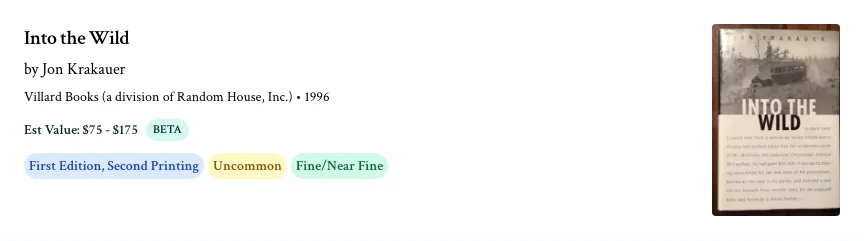
FirstFolio is an AI tool that identifies and values old books from photos. You upload pictures of the cover, title page, and copyright page, and it identifies the edition and printing, grades the condition, and returns an estimated market value range in about 60 seconds. Point it at the books you flagged to confirm which are common and which are worth pricing up.
You can check two books free, no card required. Check a book's value in 60 seconds.
What not to overprice
The flip side of catching the valuable few is not overpricing the common many. These look more valuable than they are:
- Age alone. A 150-year-old common title is still cheap.
- Leather bindings. Usually decorative reprints, low value.
- Matched sets and encyclopedias. Hard to sell at any price.
- Ex-library and book club copies. Low value, price them to move.
Overpricing these just leaves them unsold when the sale ends.
Frequently asked questions
How much should I charge for books at an estate sale? Price common hardcovers at $1 to $3 and paperbacks at $0.50 to $1, with box or bag pricing to clear them late in the sale. Price the rare exceptions individually based on real sold prices.
How do I know if a book at an estate sale is valuable? Pull anything that is a first edition, signed, in fine condition, pre-1960 fiction, or a collectible children's title, then confirm the edition and check completed sold prices for that version.
Should I price books individually? No. Bulk-price the common majority by the table or box, and only price the flagged few one by one.
What books sell best at estate sales? Popular fiction moves fast when it is cheap, but the money is in the small number of genuinely collectible books, so the priority is finding those before they sell for a dollar.
Related reading: