Are Ex-Library Books Worth Anything?
The stamps, pockets, and spine labels of a library copy usually cut collector value hard. Here is why, how much, and the few cases where an ex-library book is still worth real money.
Robin Swain
Author
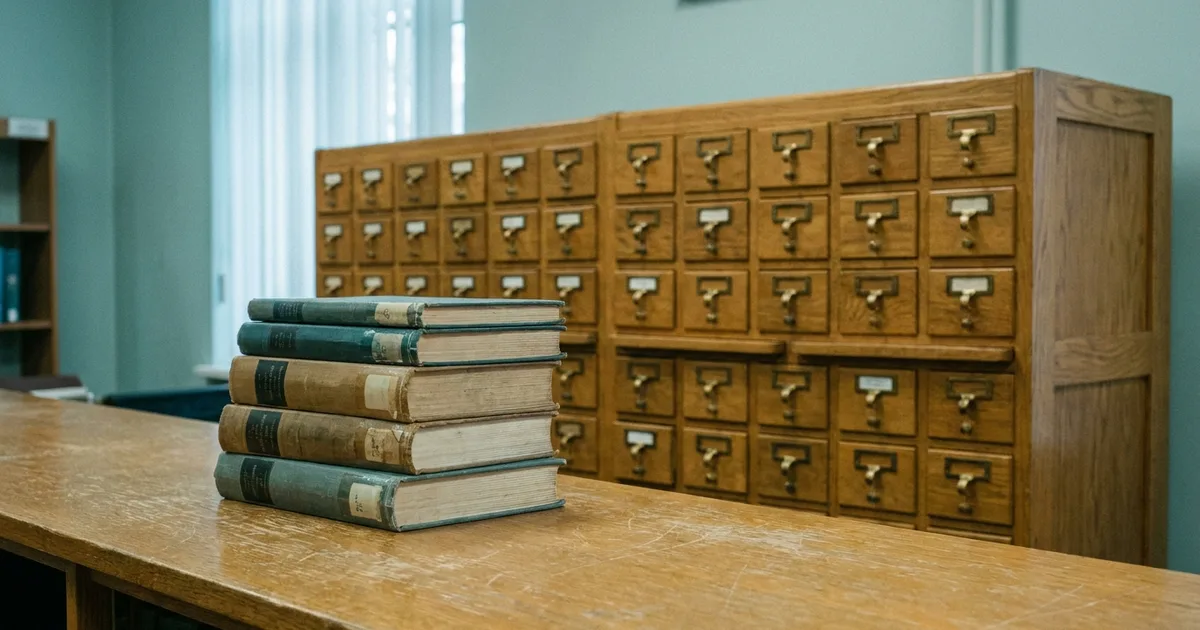
A stack of worn hardcovers with faded spine labels in front of an old library card catalog.
You found a promising old hardcover, opened the cover, and there it is: a stamp. "Property of," a card pocket in the back, a call number inked on the spine. Maybe a red "WITHDRAWN" for good measure.
That book is an ex-library copy, and you already sense the news is not great. Here is the honest version of how much it matters, and the handful of cases where it does not.
The short answer
- Ex-library copies of collectible books usually sell for a fraction of a clean copy's price. For collectible first editions the cut is commonly half or more.
- The reason is condition and permanence: library marks are everywhere on the book, and they do not come off.
- As reading copies, ex-library books are a bargain, built to survive and cheap to buy.
- The exceptions: books so rare that any copy counts, and copies from famous or historically interesting libraries, where provenance can actually add value.
What makes a book "ex-library"
Libraries process books for circulation, and every step leaves a mark: ownership and accession stamps (often on the title page, the one page collectors most want clean), a glued-in card pocket, spine call-number labels, barcodes, perforation stamps through the title leaf, taped or laminated jackets, and reinforced or replaced bindings. When the book is retired, it usually gains a "WITHDRAWN" or "DISCARD" stamp on the way out.
None of this is damage in the ordinary sense. All of it is permanent alteration, which to a collector is the same thing.
Why collectors pay so much less
Collecting is condition plus originality, and an ex-library copy compromises both. The marks cannot be removed without doing worse damage, the title page is stamped, the jacket is taped, and the binding has survived dozens or hundreds of borrowers. A collector comparing two copies of the same first edition will pay properly for the clean one and grudgingly for the library one, no matter how rare the title.
Here is how that shows up in a real assessment. Our Snow Crash example, a true first printing, carries a library classification mark and ownership stamp, and the assessment says the quiet part plainly:
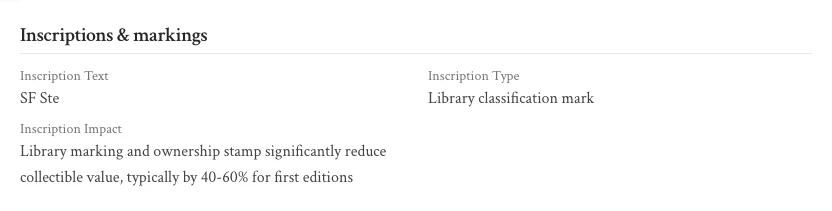
That range matches how dealers behave: an ex-library first edition commonly brings half or less of what a clean copy does, and heavily processed copies fall further. For how graders fold this in, see Book Condition Grading Explained.
When an ex-library book is still worth money
The discount is the rule. These are the exceptions worth knowing:
- Genuinely rare books. When only a handful of copies exist, any copy counts. An ex-library copy of a truly scarce title still finds buyers, at a discount, but real money.
- Famous provenance. A bookplate from a notable private library, a subscription library with history, or an institution connected to the author can add interest instead of subtracting it. Provenance is the one library mark collectors sometimes pay for.
- Reading and reference copies. As books to own and use, ex-library copies are the best deal in the trade: durable bindings, low prices, same words inside.
One warning in the other direction: a library rebind, where the original binding was replaced with institutional buckram, takes a modern first edition out of collecting contention almost entirely. The original binding is most of the object.
Selling an ex-library book honestly
Describe it as ex-library, always, with the marks listed. It is one of the standard disclosures in bookselling, buyers check for it, and an undisclosed pocket outline or stamped title page earns a return and a bad rating. Price against other ex-library copies, not clean ones. And before you list it for a dollar, confirm what the book actually is; the discount only matters on a book with value to discount. See Is My Old Book Worth Anything?
FirstFolio is an AI tool that identifies and values old books from photos. It reads the edition and printing, grades the condition, and notes library markings and their impact in the assessment, so you know whether you are holding a $4 reading copy or a discounted-but-real collectible.
You can check two books free, no card required. Find out what your copy is worth.
Frequently asked questions
Are ex-library books worth anything? Usually only a fraction of a clean copy's value, commonly half or less for collectible first editions. They remain excellent cheap reading copies, and rare titles or notable provenance can still carry real value.
Why are ex-library books worth less? Permanent alteration: stamps on the title page, glued pockets, spine labels, taped jackets, and heavy circulation wear. Collectors pay for clean, original copies.
Can you remove library markings from a book? Not without making things worse. Stamps are inked into the paper and pockets are glued; removal attempts leave damage that reads worse than the marks.
Is a withdrawn library book ever collectible? Yes, when the title is genuinely rare, or when the library itself is the story, a famous collection or an institution tied to the author. Provenance can outweigh the stamp.
Should I disclose ex-library condition when selling? Always. It is a standard, expected disclosure, and buyers who find undisclosed library marks return the book.
Related reading: