How to Spot a Book Club Edition
Book club editions copy the look of a first edition but are worth far less. Here are the tells: the blind stamp, the missing jacket price, and the cheaper build.
Robin Swain
Author
Two similar hardcover books standing side by side on a shelf, one smaller than the other.
You found a promising hardcover. The title page looks right, the copyright page even says "First Edition," and the jacket matches the pictures of the valuable one. Then a bookseller glances at it and says "book club" and the price collapses.
Book club editions are the most common false positive in book identification. They were printed by mail-order clubs like the Book-of-the-Month Club and the Literary Guild in enormous numbers, built to look like the trade edition, and they are worth a small fraction of it.
The good news is that they announce themselves once you know where to look.
The short answer
Check these, in order:
- The jacket flap price. No printed price on the inner front flap is the classic book club tell.
- The blind stamp. A small stamped dot, circle, or square pressed into the back cover near the lower right corner.
- The words. "Book Club Edition" printed on the jacket flap, or a club name on the copyright or title page.
- The build. Smaller, lighter, thinner boards and cheaper paper than the trade edition.
Any one of these is usually enough. Two together settle it.
What a book club edition actually is
Mail-order book clubs licensed popular titles and printed their own editions for members, often from the same plates as the publisher's trade edition. Same text, same jacket art, sometimes even the words "First Edition" carried over on the copyright page. What differed was the manufacturing: cheaper paper, lighter boards, and no retail price, because the book was never meant for a bookstore shelf.
That is why they fool people. The book is not a fake. It is a legitimate edition of the right book, just not the one collectors pay for.
Tell 1: No price on the dust jacket
Trade hardcovers carry a printed price on the upper corner of the inner front flap. Book club jackets usually do not, because there was no retail price to print.
One caution in each direction. A missing price corner can also mean a price-clipped trade jacket, where someone cut the price off a real first edition, so look at whether the corner is absent versus cut. And for a period in the 1970s some Book-of-the-Month Club jackets did carry prices, with "Selection of the Book-of-the-Month Club" printed on the flap instead. The flap text tells you either way. See Do Dust Jackets Affect a Book's Value? for how much the jacket itself matters.
Tell 2: The blind stamp on the back cover
Take the jacket off and look at the back board, near the lower right corner by the spine. Many club editions carry a blind stamp: a small circle, square, dot, or maple-leaf shape pressed into the cloth without ink. On some earlier Book-of-the-Month Club copies it is a small printed black dot instead.
It is subtle, and it is the single most decisive physical tell. Tilt the book against the light and run a finger over the corner. A trade edition has nothing there.
Tell 3: It says so, if you look
Some club editions state it outright: "Book Club Edition" on the jacket flap, or the club's name on the title or copyright page. Others drop the publisher's price line but change nothing else. The absence of a statement proves nothing, but its presence ends the question.
Remember that the copyright page can still say "First Edition," because the club printed from the publisher's plates. This is a case where those words do not mean what they seem to. The number line has the same problem, see How to Read a Book's Number Line.
Tell 4: The build feels cheaper
Put a club edition next to the trade edition and the difference is physical. The club copy is usually a little smaller, noticeably lighter, bound in thinner boards, and printed on cheaper paper that browns faster. The jacket stock is often thinner and uncoated. On its own this tell takes experience, which is why the flap price and the blind stamp come first. But once you have handled a few, the heft alone makes you check the back corner.
What a book club edition is worth
Honestly: usually a few dollars. They were printed by the hundreds of thousands, so rarity never enters the picture. There are a handful of exceptions where the club printing is collectible in its own right, but they are rare enough that the safe default is reading copy money.
The flip side is worth stating too. If your copy passes these checks, no blind stamp, priced jacket, trade-size build, you may be holding the real thing, and the next step is confirming the printing. Start with How to Tell If a Book Is a First Edition.
The faster way to check
FirstFolio is an AI tool that identifies and values old books from photos. You upload pictures of the cover, title page, and copyright page, and it identifies the edition and printing, grades the condition, and returns an estimated market value range in about 60 seconds, including whether what you have is the trade first or a club printing.
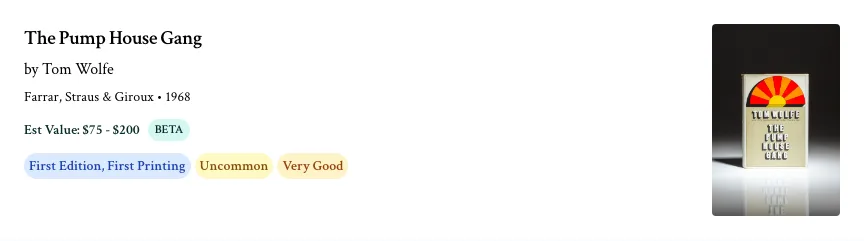
You can check two books free, no card required. Find out which edition you have.
Frequently asked questions
How can I tell if a book is a book club edition? Check the inner front jacket flap for a missing printed price, and the lower right corner of the back cover for a small blind stamp (a dot, circle, or square pressed into the cloth). Either is a strong tell; both together settle it.
Are book club editions worth anything? Usually only a few dollars. They were printed in huge numbers on cheaper materials, so collectors pay little for them, with rare exceptions.
Why does my book club edition say "First Edition"? Clubs often printed from the publisher's plates, so the copyright page text carried over. On a club printing those words do not indicate the collectible trade first.
What is a blind stamp on a book? A small mark pressed into the back cover cloth without ink, usually near the lower right corner. Book clubs used it to mark their editions.
Is a book club edition a fake? No. It is a legitimate licensed edition of the same text. It is just a mass-produced printing that collectors value far below the publisher's trade first edition.
Related reading: